

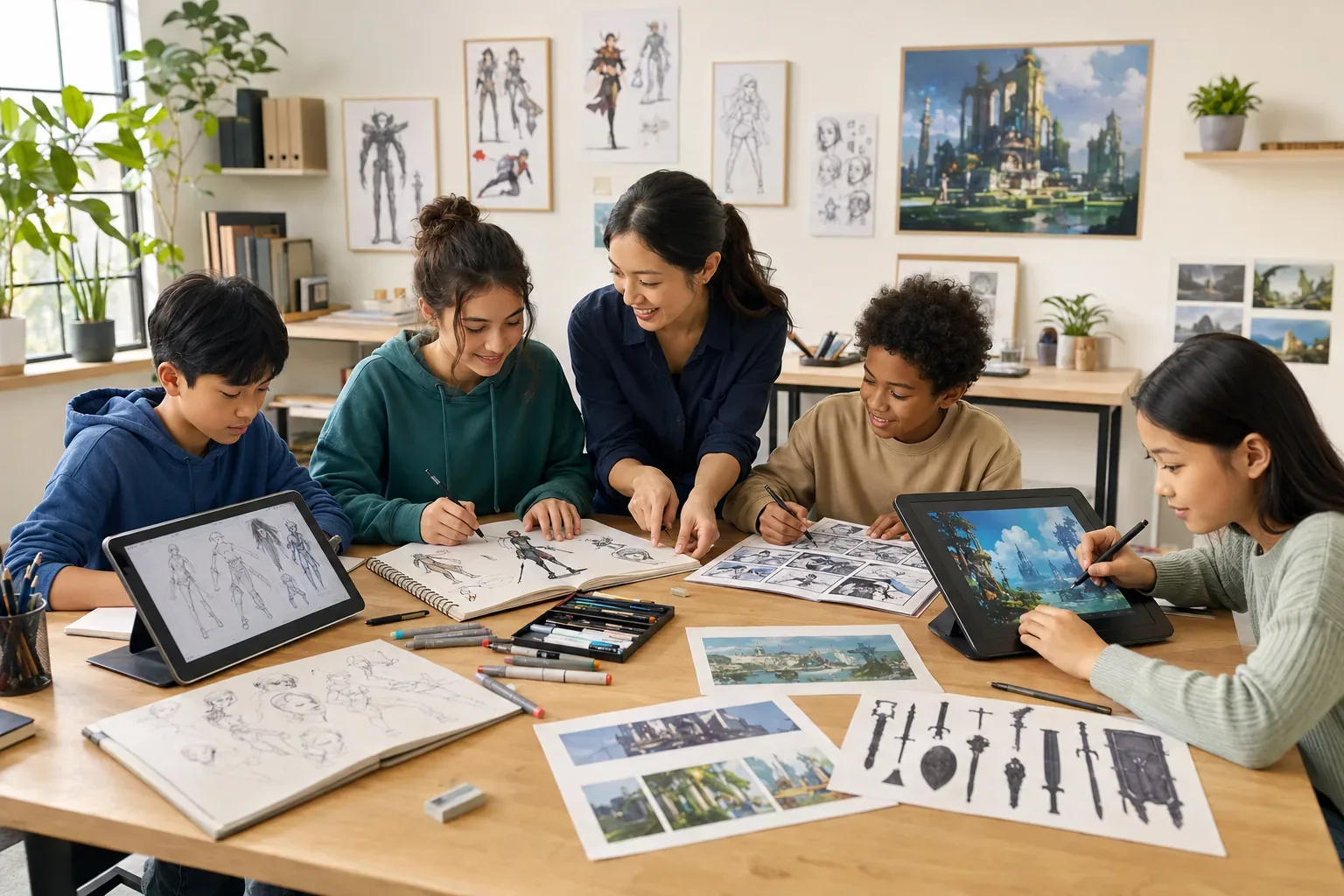
The best art pathway is usually the one that matches how a student likes to create. Traditional and digital classes share core art decisions, but the tools and workflow feel different.
Traditional Art & Design combines broad fundamentals with style
Students build drawing, proportion, line, expression, composition and character-design fundamentals while working across cartoons, original characters, anime, manga and comic art.
Anime, manga and comics now live inside the Traditional pathway
Students no longer need a separate Anime & Manga product. Stylized characters, dynamic poses, inking and comic storytelling are taught within Traditional Art & Design alongside stronger drawing fundamentals.
Digital Art & AI Design adds workflow, game art and creative technology
Digital Art & AI Design adds layers, colour, lighting, illustration, game-art thinking and responsible use of AI for ideation and iteration. The student remains responsible for creative direction and final decisions.
Interest is part of good placement
The strongest pathway is the one that motivates the student to practise while still teaching transferable art skills. Explore both pathways on our Art & Design page.
Traditional Art & Design is broader than “just drawing”
This pathway can include drawing fundamentals, cartooning, character design, anime, manga and comic art. Students work directly with physical media, which makes line control, shape, proportion and revision very visible.
Digital Art & AI Design changes the workflow, not the need for fundamentals
Layers, selections, colour tools and AI-assisted ideation can speed up parts of the process, but students still need to make decisions about composition, character design, lighting, visual hierarchy and what belongs in the final piece. The goal is to use technology intentionally rather than press a button and accept the first result.
Age and tool readiness matter
Traditional Art age groups vary by class and are matched by age and experience. Digital Art & AI Design is designed for ages 8–14 because the workflow requires more comfort with digital tools and multi-step project work.
Choose by motivation when skill level is unclear
If a student constantly sketches on paper, Traditional Art may create the strongest starting momentum. If they are already drawn to tablets, game visuals and digital character work, the Digital pathway may feel more natural. Interest is not the only placement factor, but it is a useful one.
Neither pathway locks a student in forever
Traditional and digital skills reinforce each other. A student who learns proportion, gesture and composition on paper can carry those decisions into a tablet workflow. A digital student can also benefit from sketchbook work when they want to practise observation or simplify a concept before building it on screen.
The first choice should therefore be about motivation and the most useful current environment—not a permanent label. Families can ask about switching pathways later if the student’s interests change.
The current class schedule can also matter. A pathway that fits the student’s age, interests and available time is usually a better choice than forcing a preferred medium into a class that is not the right level.
Ask about the current Art & Design classes
Art does not include a free trial. Tell us the student’s age, interests and preferred medium and we will confirm the most suitable current class.