

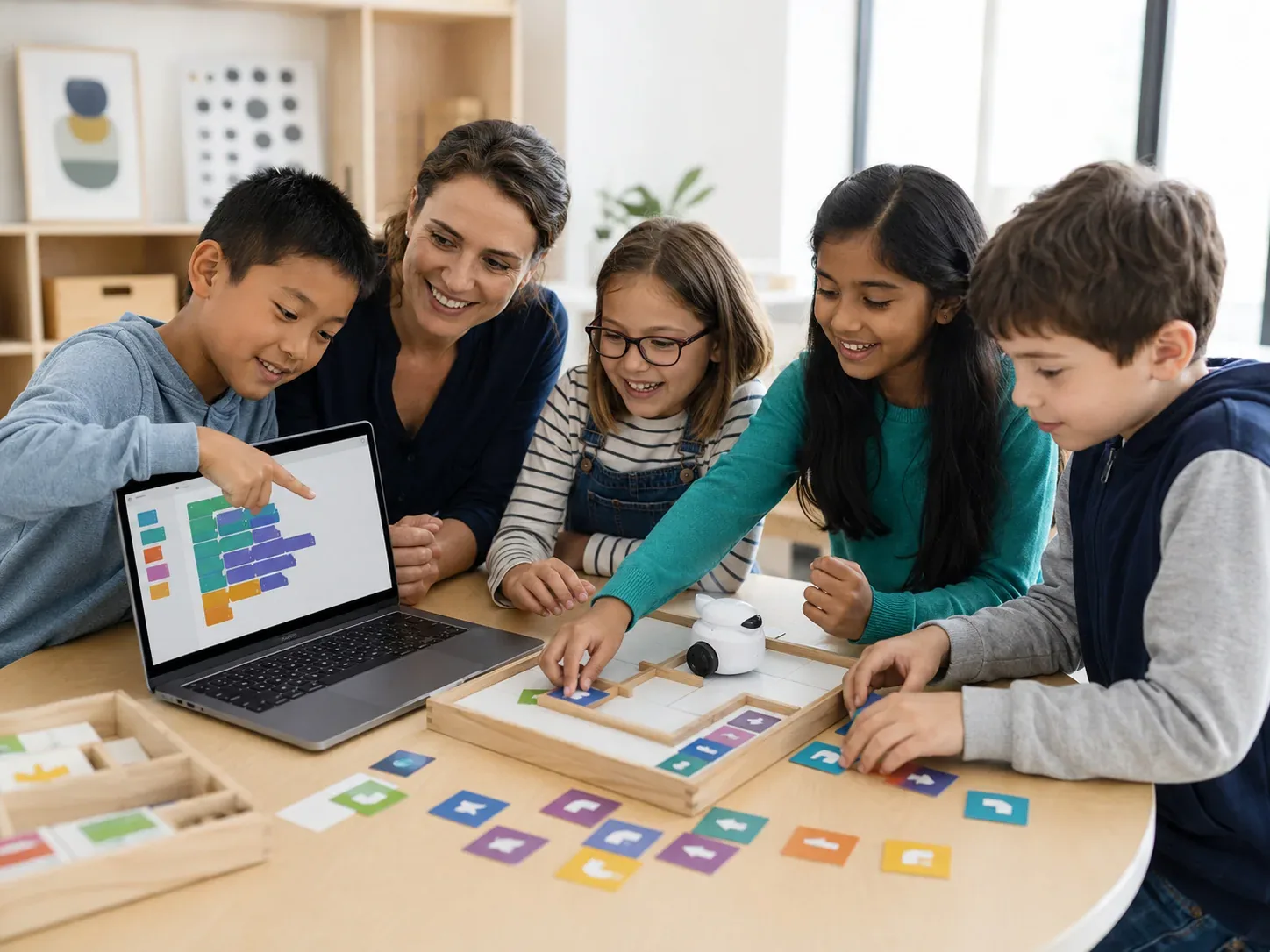
Moving to Python is a change in how a child expresses logic, not a graduation prize for finishing enough Scratch projects. Look for independence, debugging habits and reading comfort.
Look beyond “finished lots of Scratch projects”
A student may complete many projects by following steps without understanding the logic. Readiness is stronger when the child can explain loops, conditions, variables and events in their own words.
Independent debugging matters
Text coding introduces syntax errors in addition to logic errors. Students who can test, inspect and revise their own Scratch work are usually better prepared for that extra layer of difficulty.
Typing and reading stamina can affect the transition
Python is relatively readable, but text coding still requires accurate typing and attention to error messages. A student may understand the logic before they are comfortable with the mechanics.
A bridge is often better than an abrupt switch
Students do not have to abandon visual coding immediately. A class can introduce Python while continuing to use familiar creative tools. Our coding pathway adjusts based on age and experience.
Python removes some of Scratch’s visual safety rails
In Scratch, many syntax mistakes are impossible because blocks fit together in limited ways. Python asks students to manage spelling, punctuation, indentation and text-based error messages while still thinking about the underlying logic. That extra load is useful only when the student is ready for it.
Look for independence before speed
A child does not need to build complicated Scratch projects before moving on. More important signals are whether they can explain what a block sequence does, break a task into smaller steps and try a fix when something fails instead of waiting immediately for an adult.
Do not rush the transition because Python sounds more advanced
Text-based programming is not automatically better learning. A student who is still developing logic may learn faster by staying in a visual environment a little longer. The goal is to increase challenge without adding so much typing and syntax that the actual programming ideas get lost.
A bridge project can make the move easier
One useful transition is to rebuild a familiar idea in Python: a score counter, simple quiz, movement logic or small game rule. Because the concept is already known, the student can focus on how text-based code expresses the same logic differently.
Signs a child may be ready now
They can explain the logic of a project in their own words, use variables and conditions with purpose, debug simple problems without immediately asking for the answer, and stay comfortable reading short instructions. None of those signals requires advanced Scratch artwork or a huge project portfolio.
If those habits are present, Python can be a useful next challenge because it shifts attention toward text-based structure while keeping the same core ideas of sequence, conditions, loops, functions and data.
If a child is unsure, there is no disadvantage in using both environments for a period. A mixed transition can preserve creative momentum while gradually increasing the amount of text-based programming.
Choose the next coding step
If you are unsure whether your child should stay with visual coding or move into Python, a real Coding class can show which environment fits now.